
Technology is easy but people are hard. In particular, communications are hard. They’re the physics of human interaction—the $F=ma$ of how we get things done—and when the forces don’t align, things get high-stakes fast. I learned this the hard way when Perry Clark almost fired me.
The Communication Pipeline
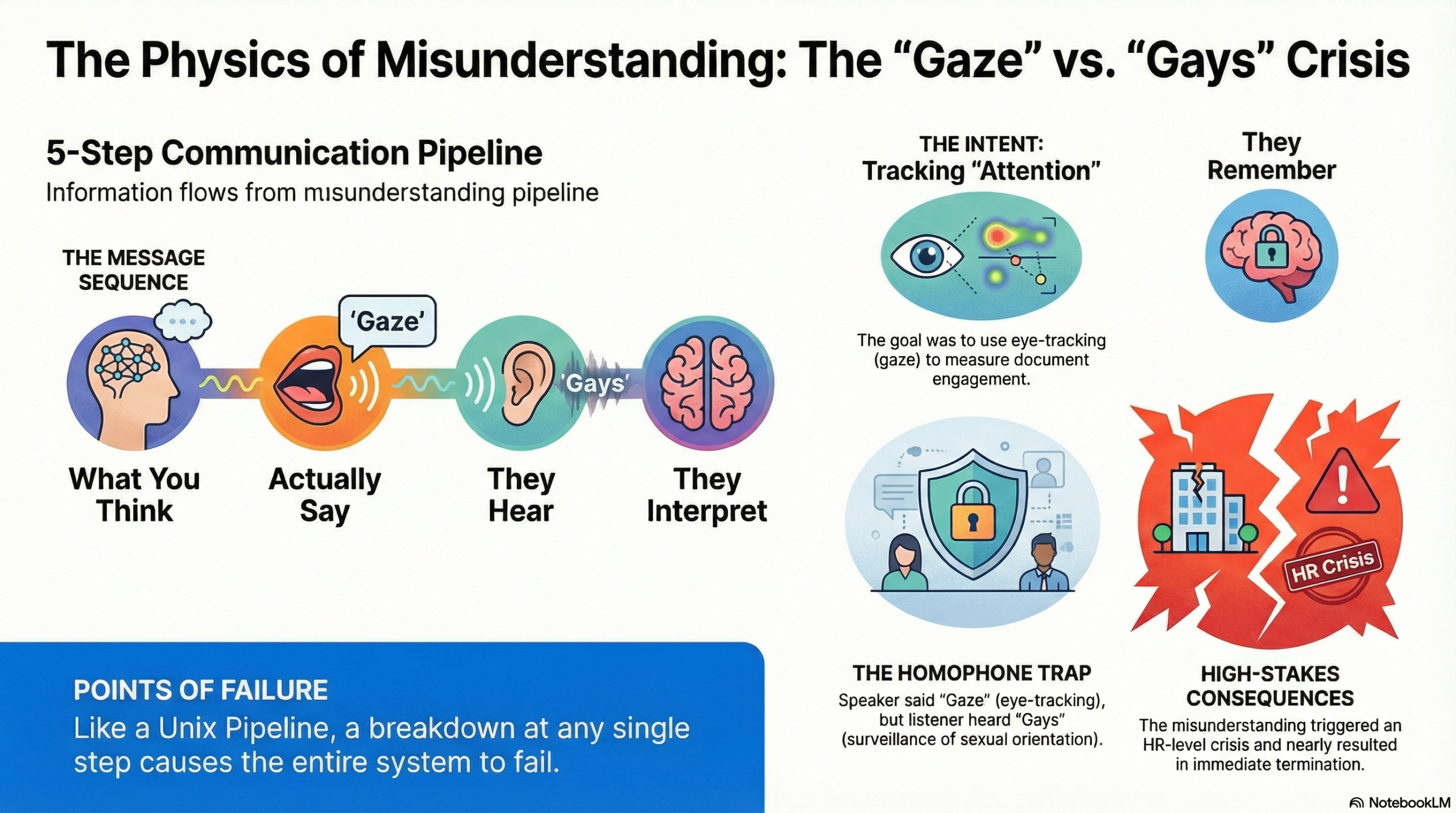
Before we get into that boof-a-rama, let’s look at the theory of communications. To diagnose a tricky situation, you have to understand the underlying mechanics. Communication isn’t a single event; it’s like a traditional Unix Pipeline where you use prayer-based parsing and hope everything connects correctly. Here are the steps:
- What you think.
- What you actually say.
- What they hear.
- What they think it means.
- What they remember.
At any step, this process can go pear-shaped. When there’s a misunderstanding, you always want to think through these steps to find the point of failure.
The Request: Solving for Attention
At the time, I was the AI architect for M365. Perry and I would have these brainstorming sessions where he’d firehose out a brilliant stream of ideas and I’d go off to investigate them.
Perry had a great idea: to improve user productivity, we needed to understand attention. Having a document open for an hour doesn’t mean anything if the user isn’t actually looking at it. If they are looking, that’s an interesting signal. He wanted to know: could we figure that out?
That Didn’t Go The Way I Expected
I tracked down some researchers who had models for this. They could track exactly where someone was looking on the screen. It was computationally expensive—consuming an entire CPU—but with a modern NPU, it was feasible.
At my next one-on-one, I told him: “Hey Perry, I followed up on your request to track gaze, and we can do it.”
Perry looked at me like I had a rat’s tail coming out of my mouth. It was that visceral sense of disgust and total misunderstanding. I double-downed, explaining that we could reliably detect “gaze” and track it. I thought I was delivering the “What” he wanted, but I hadn’t checked the “Why.”
Perry confusion turned to anger. I swear he was on the edge of firing me. He said, “Jeffrey, I never told you to track GAYS.”

The Lesson: Getting Comfortable with Being Uncomfortable
In that moment, I realized we had a failure to communicate. I was talking about eye-tracking (g-a-z-e), and he thought I was suggesting some horrific, HR-disaster surveillance of people’s sexual orientation.
I was able to remedy the situation and keep my job, but it was a sobering reminder. If you get your communications wrong:
Oy vey, Jeffrey. 🙂
This could be an episode of South Park.