I’ll never forget the day the world stopped. I picked up the phone and heard: “Hello. This is LCA. I’m calling to inform you that you are the subject of a formal investigation into anti-trust violations.”
At that point, everything got blurry. I think I forgot to breathe for a few minutes. I was in shock.
A Broken Windows Configuration Management Ecosystem
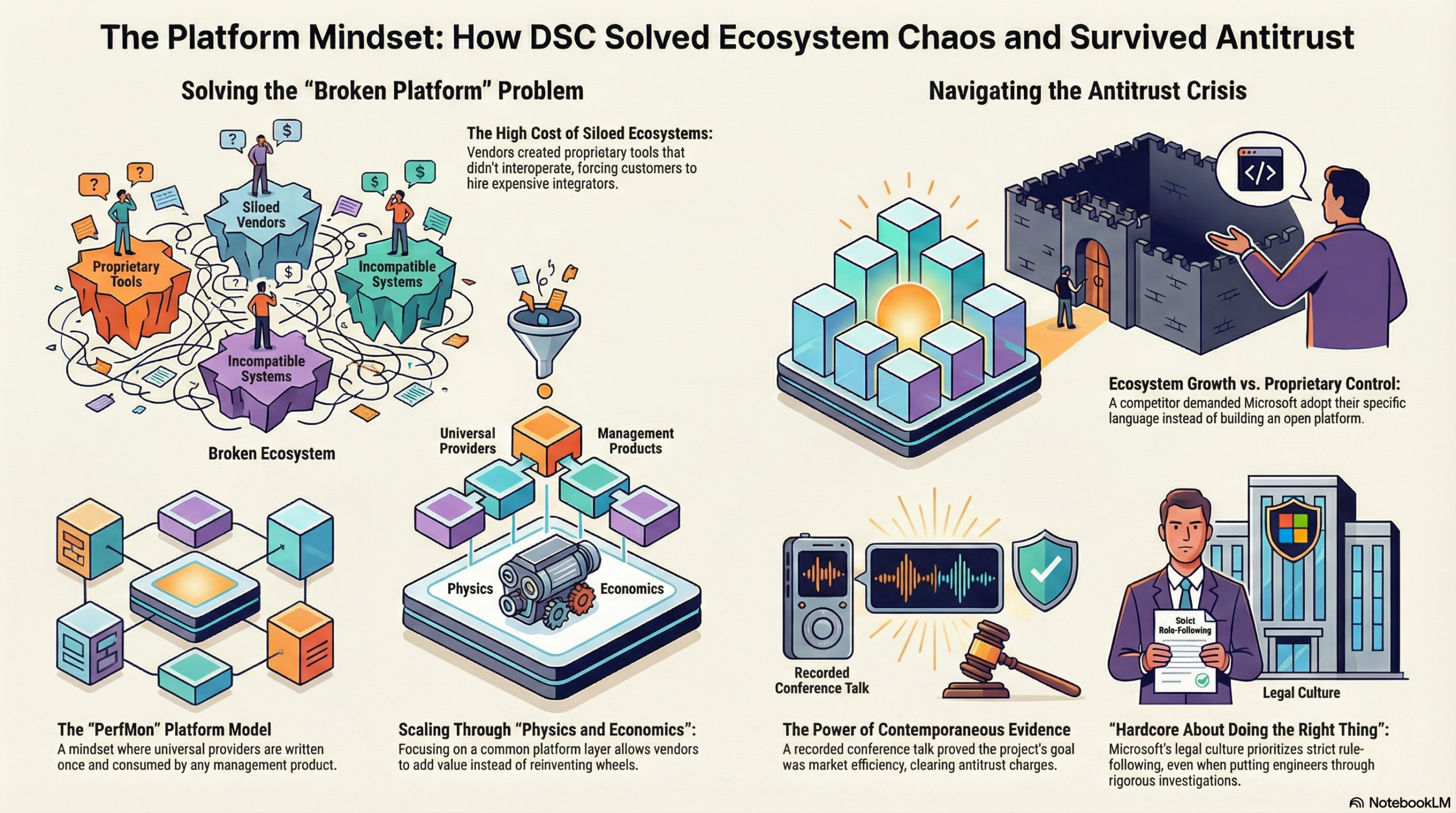
Back then, Windows had a classic broken platform problem. We had multiple configuration management vendors, but they were all completely siloed. Vendor A would work with the SQL team to get a provider, but that provider only worked with Vendor A’s tools. It was the same story with Vendor B and the Exchange team.
This mess created a broken ecosystem that was failing our customers, vendors, and management tool suppliers. If you wanted to manage your infrastructure at scale, you were forced to pay for exorbitantly expensive systems integrators because nothing worked together.
PerfMon – the Perfect Platform Pattern
When I designed PowerShell Desired State Configuration (DSC), I wanted to reuse the PerfMon pattern. I’ve long considered PerfMon to be the perfect model for management because it understands the physics, and economics, of the problem.
Think of it like this:
Instrumentation: PerfMon defined a simple way to instrument the world and lit up that instrumentation with a simple in box tool. All the vendors wrote providers, and their data showed up seamlessly in the GUI. But the real magic was that any vendor could reuse those providers. Their platform mindset created a very happy ecosystem!
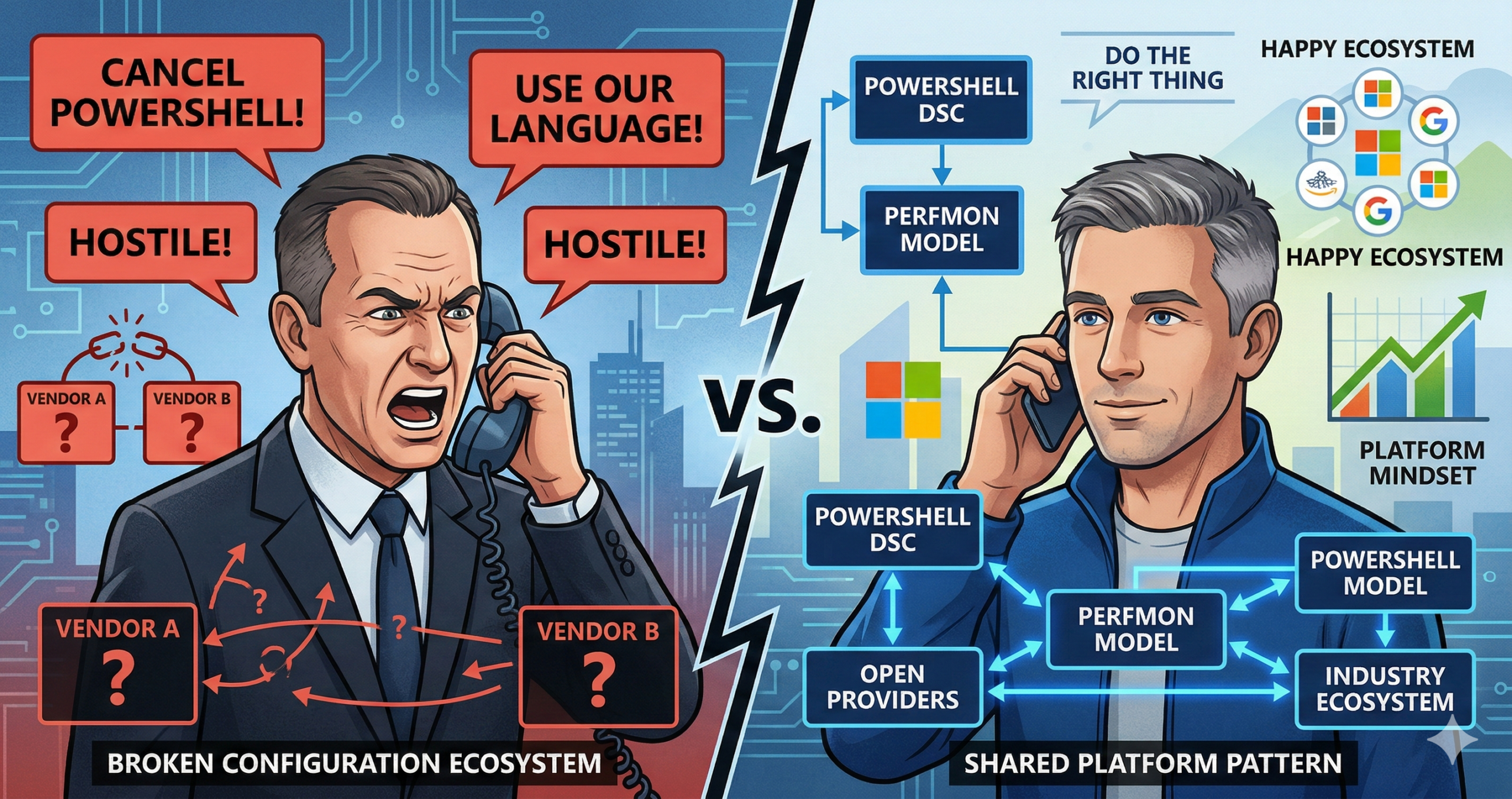
That was my model for DSC. Anyone could write a provider, and those providers could be consumed by any management product. It was about creating an industry ecosystem where vendors could focus on adding real value instead of reinventing the wheel.
The Boof-a-Rama
While I was announcing DSC at TechEd, I met with the CEO of a configuration management vendor as a courtesy. We had already been briefing his organization, and they seemed to like the model. So my goal was to make sure that he knew that he could reach out to me directly if they experienced any issues.
I had no idea that things would go so pear-shaped.
When I mentioned that PowerShell was going to deliver a simple, in-box tool, he got … well I think it fair to use the word ‘hostile’. He adamantly, and animatedly, insisted we cancel PowerShell and adopt his company’s language instead.
I explained the perfmon model and he agreed on this approach, but again insisted that it was his language. I explained that his path wouldn’t achieve the goal. I asked him: “Say we wanted to go down that path, do you think your competitor would be in or out?” He didn’t care, he was adamant. I said that at this layer, we would just have to agree to disagree but that if we can agree at the platform layer, I could do the heavy lifting of getting industry support and his tool would greatly benefit from that.
I went on to give my conference talk, explaining how we wanted to increase the size and efficiency of the market so everyone—including him—could succeed.
Enter the scary lawyers
Fast forward a few weeks, and I’m sitting with the lawyers. They informed me that a competitor—you can guess who—had filed an anti-trust complaint based on my work.
They asked for contemporaneous notes. I didn’t have any, but I had something better: a recording of the talk I gave just two hours after that hostile meeting. I told my story, and because I was telling the truth, everything lined up with the recording.
After an awkward pause, the lawyer asked: “Do you have any idea what the hell this guy is talking about?” I just said, “Sorry, no.”
They closed the investigation then and there. It was a scary experience, but it reinforced my respect for Microsoft LCA and the culture Brad Smith built. They were hardcore about doing the right thing, even when it meant putting their own engineers through the wringer to ensure we were playing by the rules.