
A Microsoft engineer (the awesome .Net Perf architect, inventor of the phrase “Pit of Success”, and now Distinguished Engineer Rico Mariani) recently told me he used Copilot to script a way out of a laggy system. He was delighted. The story triggered a memory from the early days of PowerShell when my diplomacy was clearly … pre-operational.
A reorganization meant I had to demo the tech to my new boss. The nightly build was broken. Instead of a demo, both of us spent most of the hour trying to figure out why Windows was thrashing. We tried every tool we had. We were failing and had no clue why.
Here is how the conversation went (J is Jeffrey; B is Boss):
J: Do you have any clue what is going on?
B: Nope.
J: How long have you been working on Windows?
B: 20 years.
J: Are you an idiot?
B: WHAT!?!?!?
J: You’re not an idiot are you?
B: No.
J: RIght I know that! You have a PHD in Physics.
So here you, one of the smartest guys on the planet that has spent 20 years building this OS and you can’t figure out why it is failing.
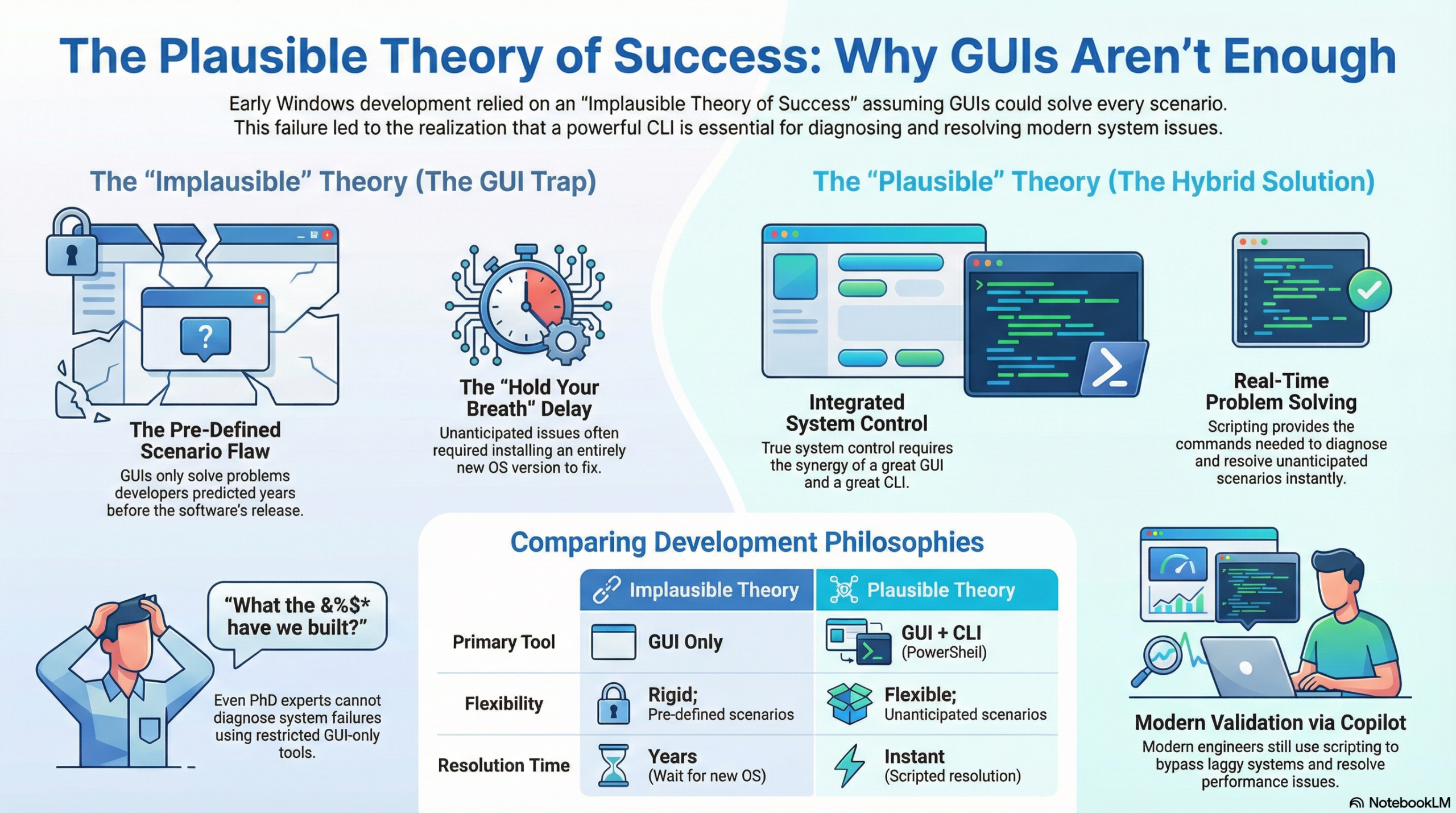
WHAT THE &%$* HAVE WE BUILT?
Windows was operating with a very clear Theory of Success: “Identify the users’ scenarios and then deliver GUIs to solve them. We win because GUIs are easier than CLIs”.
There is a big difference between a Theory of Success and a PLAUSIBLE Theory of Success.
Our Theory of Success was completely IMPLAUSIBLE!
The model failed as soon as it encountered a scenario that we had not decided to solve a couple years ahead of time. The response was essentially, “That is a new scenario that we’ll solve with a new GUI. Just hold your breath for a couple of years and then install a whole new OS and you’ll have a great solution.”
As my Microsoft buddy just reconfirmed: A Shell/scripting language with the right set of commands is required to explore, diagnose, and resolve unanticipated scenarios.
The argument I made and ultimately succeeded at was: A PLAUSIBLE Theory of Success required Windows to have a great GUI AND CLI.
The idea of a ‘plausible Theory of Success’ really resonated with me. It’s easy to get comfortable with a model that worked for a while, but tech moves so fast that assumptions can quickly become roadblocks.
Jeffrey, super juicy summary, but it’s no fun if you don’t name names it I’ll steal your ridiculous toe shoes.
(Hi! Congrats on retiring and I know exactly who you are talking about)
I’m trying to decide whether to publish a blog entry, “That time I accidentally got my boss fired”.
You definitely should. If you run into problems blame it on me!.✌️
Plausible, means possibly with a certain degree of success, in theory. Which still equates to “Huh?”. Interesting play on words. Just kidding, but it’s like calling a bug in some application, a feature that needs improvement. You can spin it anyway you want to.