
Business is usually complicated, but sometimes a cartoon explains the disaster in your boardroom better than any consultant ever could.
You remember the “Underpants Gnomes” from South Park, right? They had this incredibly industrious, high-energy business plan that looked like this:
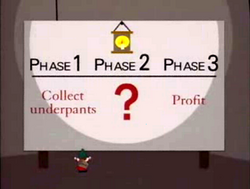
I look around the enterprise landscape right now, and I see a lot of very smart, very panicked executives acting exactly like those gnomes. Boards are terrified of missing the “AI boat,” so they pressure the CEO. The CEO turns around and screams at their staff, and suddenly the entire organization is lurching at the nearest shiny AI object.
They are nailing Phase 1: They are collecting the underpants. They are getting AI products, they are measuring their internal usage, they are rewarding the people that are using the most AI and punishing those that don’t, etc.
They are definitely expecting Phase 3: The profit. The revolution. The magical ROI.
But few have a clue what Phase 2 is. And that giant question mark is where your strategy is going to die.
The 95% Disaster
We are seeing the results of this “Gnome Strategy” play out in real-time. A MIT study The GenAI Divide STATE OF AI IN BUSINESS 2025 came out in August 2025, and the numbers are a bloodbath: 95% of organizations are getting zero return (or no measurable P&L impact) from their Generative AI initiatives.
Now, I’m a guy who believes in the growth mindset. I’ve always said you need to get comfortable with being uncomfortable. At Microsoft we had a “Best Failure” award and a “Share your Fail” speaking series because if you aren’t failing, you aren’t trying hard enough.
But there is “good failure,” where you test a hypothesis and learn the physics of the problem, and then there is “stupid failure,” where you set money on fire because you didn’t do the work.
This 95% failure rate isn’t a sign of ambitious innovation. It’s a sign of laziness. It’s a sign that companies are treating AI like a magic wand rather than an engineering problem. When developing PowerShell I would say that you can’t use “prayer-based text parsing” and get a reliable system. So too, you can’t use “prayer-based strategy” to get an AI transformation.
The Plausible Theory of Success
Years ago, when Satya Nadella first “welcomed me to the room” as a newly minted executive, he was very explicit: to stay in that room, I had to always had to have a Plausible Theory of Success. A clear understanding of what the situation was, grounded in the realities of the market and the strengths and weakness of the organization and then a theory about how to use the resources to generate customer success.
When I was fighting for PowerShell, I had executives look at me like I had a rat’s tail coming out of my mouth. They didn’t get it. To win, I had to articulate the theory of success (the Monad Manifesto) —the logical path from where we were to where we needed to be and how that was going to deliver business success.
A Plausible Theory of Success isn’t a wish. It isn’t “we will use AI to get better.” That is a hallucination.
A Plausible Theory of Success requires you to map out that missing Phase 2:
- Market Realities: What are the actual friction points your customers hate?
- Organizational Physics: What are you actually good at? Don’t tell me you’re going to out-innovate OpenAI. You aren’t. But you know your customer’s data better than they do.
- The Mechanism: How exactly do you apply resources to change the outcome?
If you cannot articulate the mechanism—if you cannot draw the line from a GPU to the customer value—you don’t have a strategy. You have a pile of underpants.
Stop lurching.
Stop half-assing your planning.
Sit down, embrace the discomfort of the blank whiteboard, and figure out your Step 2.
So thougtful in how Powershell makes AI a reality.
Do you really think that AI bubble that we are part of will really change the world or is it like any other technology bubble that will in end result in just few companies reaching valuation of trillions of dollars?
I am a strong believer in the the long term broad benefits of AI.
The reason is that AI is high volume/low cost synthetic thought.
Thought is the driver of advancement.
That is why I’m most optimistic about AI APPLIED to an area – material science, biology, etc. vs AI in and of itself.
As a geek – I’m excited by the pure technology of AI but as a human,I’m excited about the APPLICATION of AI.
Pingback: Getting the AI Hype Cycle Right | Jeffrey Snover's blog
Pingback: AI Ages Like Fresh Fish: The Brutal Economics of Technological Deflation | Jeffrey Snover's blog