There is an ongoing conversation happening right now between three camps: the AI Accelerationists, who want ‘all gas no brakes”; the AI Safetyists, who want to slam on the brakes; and the AI Skeptics.
The first two camps get all the press because they deal in extremes—utopia or apocalypse and extremes drive the attention economy. But we need to pay attention to the Skeptics. There is a taxonomy to the camp of skeptics; some don’t think AI is going to do what people say it will; others believe that it is a distraction from more pressing issues; and some are all about the economics and the math. The skeptics in this discussion aren’t arguing about the soul of the machine or killer bot swarms; they are arguing about the math. And from their perspective, the math is no bueno. MUY no bueno.
I recently listened to the Goldman Sachs discussion, “A skeptical look at AI investment”, and it outlines a massive discrepancy between the “hope” of the AI industry and the “physics” of economic reality.
The $1 Trillion Price Tag
The headline figure in this discussion is staggering. The industry is gearing up for $1 trillion in capital expenditure over the next few years. That includes data centers, chips, utility upgrades, and the grid itself.
Jim Covello, the Head of Global Equity Research at Goldman, lays out the core friction here. To earn an adequate return on a $1 trillion investment, this technology doesn’t just need to be “cool” or “helpful.” It needs to solve immense, complex problems.
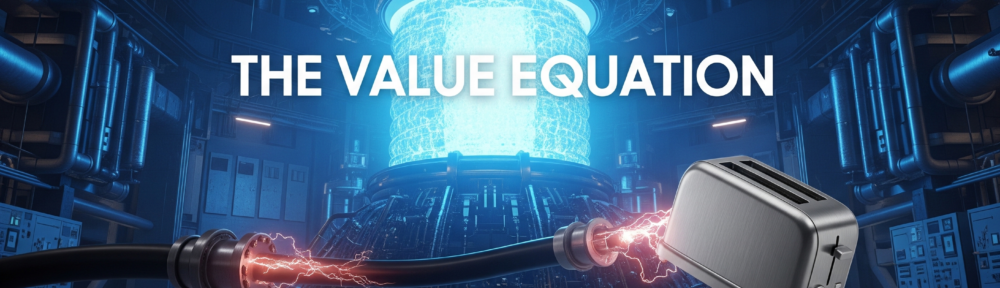
Covello argues that today’s AI suffers from a fatal paradox: it is too unreliable to solve complex, high-value problems (due to hallucinations), yet too expensive to replace simple, low-value workflows. He is essentially saying that we are building a nuclear reactor to power a toaster.
This mirrors what Microsoft CEO Satya Nadella said in early 2025. Pushing back against the abstract hype surrounding Artificial General Intelligence (AGI), Nadella argued that technical milestones are irrelevant without a slime trail of value. He stated that the true measure of success is measurable global economic growth. Specifically, he noted that if we are going to compare this AI wave to the Industrial Revolution, we should see “Industrial Revolution type of growth.”
The “Internet 2.0” Analogy is Flawed
The discussion points out that people love to compare this to the early days of the Internet, saying, “Build it and they will come.” But the discussion points out a fundamental difference in the “physics” of these two eras.
When the Internet disrupted commerce, it replaced high-cost incumbents with low-cost solutions. It was cheaper to buy a book on Amazon than to drive to Barnes & Noble.
The Skeptics argue that Gen AI is the inverse. We are taking low-cost human interactions—like writing an email or searching for a file—and replacing them with incredibly high-cost compute cycles. As Covello notes, “AI technology is exceptionally expensive, and to justify those costs, the technology must be able to solve complex problems, which it isn’t designed to do.”
That made me think about the insane amount of Kflops I consumed doing multiple NanoBanna images for fun images in a talk I recently gave. It was a great talk and those images were fun but…. economic value … maybe not so much.
I found this to be a very interesting argument, but I am not sure it reflects the incredible deflationary costs of inference that the industry is currently seeing. In a recent podcast, Dr. Alexander Wissner-Gross, a computer scientist and founder of Reified, claimed that we were seeing a 40X deflation in the cost of intelligence (specifically, the cost per unit of intelligence for both AI training and inference). If the cost curve is bending that fast, the Skeptics’ math on the “price equation” might be outdated sooner than they think.
The Productivity Gap: 9% vs 0.5%
The discussion features a debate between Goldman’s own economists and MIT professor Daron Acemoglu. The optimists predict AI will drive a 9% increase in productivity and a 6% boost to global GDP.
Acemoglu looks at the data and sees something very different. He estimates only 0.5% productivity growth and a mere 0.9% GDP boost over the next decade.
Why the massive gap? It comes down to what is actually automatable. Acemoglu argues that truly reliable, cost-effective automation will only apply to about 5% of tasks in the near term. Humans are actually very efficient at what they do. Trying to force a probabilistic model to do a deterministic job is often more trouble than it’s worth.
I would love to see a taxonomy of tasks and 1) the applicability of those tasks to automation; 2) the current economic value of those tasks; 3) whether automating the task provides a path to increased usage or merely cost savings. Does anyone have a pointer to anything like this?
The “Field of Dreams” Strategy
The current industry strategy is driven by FOMO (Fear Of Missing Out). The discussion highlights that CEOs are spending billions on GPUs not because they have a clear use case that improves their margins, but because they are terrified of looking behind the curve.
This is a “Field of Dreams” approach: If we build the data centers, the killer app will come.
The discussion draws a sharp parallel to the late 1990s. The infrastructure builders (like Cisco and Lucent) boomed, but the capacity they built vastly outstripped the demand. It took over a decade for the “killer apps” to actually utilize that bandwidth. I think you have to take this point with a large grain of sand. I’ve seen other arguments that point out that during the 1990s, something like > 95% of the fiber laid was dark (unused) and that there are NO dark GPUs. So I think the argument would have to be made, not on lack of demand but rather on lack of economic value of that demand (e.g. chats with your ‘AI friend’).
It can reasonably be argued that this specific “AI Moment” was caused by Satya Nadella’s fear of Microsoft missing another “platform moment.” We missed the shift to Mobile, and then had to fight tooth and nail to catch the shift to Cloud after giving AWS a 5+ year head start. Nadella is likely driving this hard specifically to ensure they do not miss the platform shift to AI, regardless of the short-term cost inefficiencies.
The Optimist’s Weigh In:
It is important to note that the Goldman report isn’t a monolith of skepticism. Goldman analysts Kash Rangan and Eric Sheridan argue that the “physics” of this cycle are actually more favorable than the dot-com era.
Sheridan notes that while the absolute dollar amounts are massive, the current capital expenditure (CapEx) as a share of revenue doesn’t look markedly different from previous tech cycles. Furthermore, Rangan argues that the potential for returns is actually higher this time because the spending is being driven by massive incumbents rather than speculative startups. These companies have low costs of capital, established distribution networks, and massive existing customer bases. They aren’t building a road to nowhere; they are widening the highway for traffic they already own.
The Verdict
The Skeptic POV in this discussion is essentially questioning the architectural/economic sanity of our AI efforts.
I’ve always said, software works when it works, and fails when it fails. The Skeptics are simply pointing out that spending $1 trillion for a system that works sometimes is a price equation that eventually has to balance out. In other words, stop admiring the technology and start auditing the value.
These arguments are worth chewing on.
Most people in the industry growing up reading the same science fiction novels – we all have imagined what a future of and economics of intelligence on tap looks like because we’ve “seen it”. In reality Star Trek works when running as a TV show but it’s likely “the Federation” doesn’t as an actual economic entity. It’s all a bit Platonic – philosophers decide on a utopia and then work backwards to invent arguments that would (in theory) get people there (rather than building the utopia through Aristotelian trial-and-error).
A fantastic article from the PowerShell Architect and an OS Architecture expert.
I agree with everything you said, Jeffrey, but I’m looking at the current AI hype from a completely different—and much more crucial—angle.
Think about the Space Race:
The U.S. spent $25.8B on Apollo (≈$280B today).
The Soviet Union invested an estimated $12–$15B (≈$130–$160B today) to compete.
Combined, that’s roughly $400B in today’s dollars for a race to the Moon.
Now compare that to AI:
Global AI spend is projected to hit $2T by 2026.
North America alone will account for $700–$800B.
That’s 5–7x the Space Race—and for good reason. The Moon was symbolic. ASI is existential. Whoever gets there first doesn’t just win prestige; they could control the most transformative technology in human history.
But here’s the kicker:
The Space Race didn’t just put footprints on the Moon—it delivered massive economic benefits through tech spinoffs like semiconductors, GPS, and advanced computing. NASA estimates its programs now generate $75B annually for the U.S. economy, and McKinsey projects the global space economy could reach $1.8T by 2035. [https://www.nasa.gov/fy-2023-economic-impact-report/], [https://www.mckinsey.com/industries/aerospace-and-defense/our-insights/space-the-1-point-8-trillion-dollar-opportunity-for-global-economic-growth]
If AI follows a similar trajectory, the economic upside could be 5–7 times greater than the Space Race’s long-term impact—potentially adding $20T+ to global GDP by 2030. [https://www.businesswire.com/news/home/20240917263850/en/IDC-Artificial-Intelligence-Will-Contribute-%2419.9-Trillion-to-the-Global-Economy-through-2030-and-Drive-3.5-of-Global-GDP-in-2030]
So beyond the strategic imperative of winning the AI race, the economic multiplier effect is staggering.
This isn’t hype—I feel that it’s a generational inflection point.
Pingback: Getting the AI Hype Cycle Right | Jeffrey Snover's blog
Pingback: AI Ages Like Fresh Fish: The Brutal Economics of Technological Deflation | Jeffrey Snover's blog