I used to get horrible jet lag.
Not the “a little groggy” jet lag.
More like the “find a reason not to go” flu symptoms type jet lag.
A few years ago I finally dug into the science, thanks largely to Satchin Panda’s work at the Salk Institute. I’ve now run my protocol on more than 12 international trips. Jet lag has gone from the thing that wrecked my trips to pretty much a non-event.
People keep asking how I do it, so here it is. But I’m not going to hand you a list of tips. Tips without a model are voodoo. Once you understand the science of why jet lag happens, the fixes become obvious, and you can debug your own trips.
Every cell in your body has a clock
Start with three facts from biology:
- Bio 101: Your genes do their work by making proteins.
- Bio 202: Most genes aren’t on all the time. Their output rises and falls across the day.
- Bio 303: That rhythm is everywhere. In 2014, researchers sampled 12 organs in mice every two hours for two days. Nearly half the genes that make proteins (43%) switched up and down on a daily cycle in at least one organ.
NET: every cell in your body has a clock, and each tissue runs its own schedule.
Why would evolution build it this way? Energy. Making proteins is one of the most expensive things a cell does, and evolution is ruthless about wasted energy. There’s no point running the food-processing line at 3 a.m. when no food is coming. So your body ramps up the machinery for digestion around the times you normally eat, and winds it down while you sleep.
Think of your body as a factory running shifts. The liver crew that processes a meal clocks in around when you normally eat. The repair crew clocks in while you sleep. Each shift brings out the tools, the proteins, for its job.
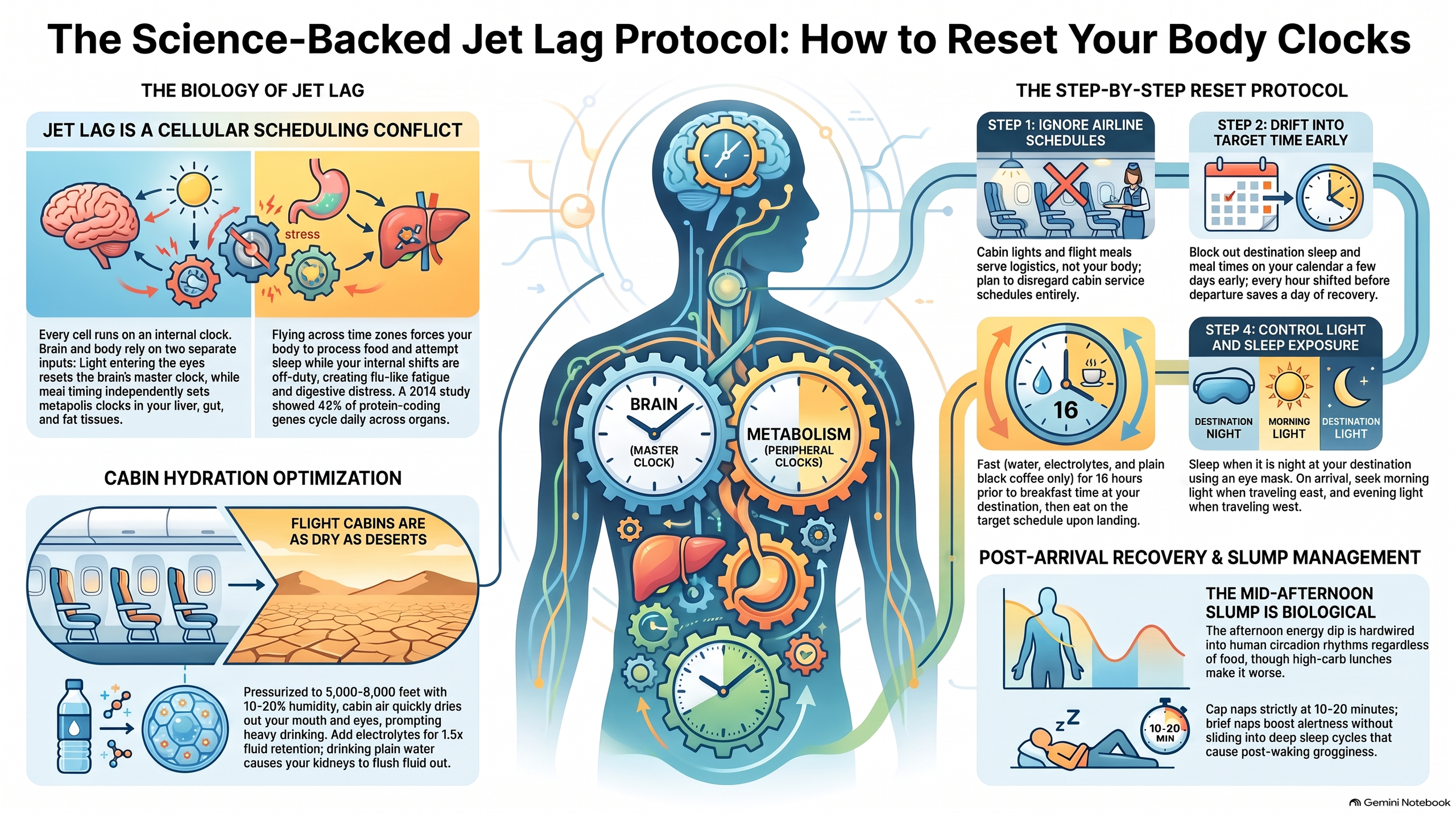
Now fly to Tokyo. Dinner shows up at the loading dock at 3 a.m. body time. The meal crew is home in bed and the tools are locked up. Your body tries to do the work anyway, badly. That’s the fog, the broken sleep, the flu-like symptoms and the upset stomach. Jet lag is a scheduling problem.
Two dials reset the clocks: light and food
If jet lag is a scheduling problem, the fix is to reset the schedule. Your body takes its timing cues mostly from two inputs.
Light sets the master clock. It sits in your brain, wired to your eyes. Morning light pulls it earlier; evening light pushes it later.
Food sets the metabolic clocks. Your liver, gut and fat pay more attention to when you eat than to the sun. In a 2017 human study, delaying meals by five hours shifted blood-sugar rhythms by about five hours, while the brain’s master clock didn’t move.
That’s the key insight. Shift only your light and your brain resets while your metabolism drags behind. Shift only your meals and you get the reverse. You have to turn both dials, in the same direction, at the same time.
The protocol
Step 1: Recognize that the airline is working against you
Airlines don’t mean to, but they get almost everything backwards. The cabin lights are on when you should be asleep. The meals arrive when you should be fasting. The service schedule is built around logistics, not around where your body needs to end up. Plan to ignore it.
Step 2: Get on destination time before you leave
Open your calendar and block out when you’ll sleep and eat in the destination time zone. Then start drifting toward that schedule a few days ahead. Every hour you shift at home is an hour you don’t have to fight on arrival.
Step 3: Use a 16-hour fast to reset your food clock
Figure out when breakfast is at your destination. Fast for at least 16 hours before it, then eat on the destination schedule from that meal on.
This comes from a 2008 Harvard study that found a food-driven clock in the brain. In mice, a single cycle of fasting then refeeding moved their rhythms onto the new mealtime. Skip the food on the plane, then eat as soon as you land.. The closest human evidence is older: National Guard troops who used the Argonne feast-and-fast diet before crossing nine time zones had significantly less jet lag than those who didn’t.
Fasting means water, electrolytes and black coffee. No sugar, no milk, no “just a snack.”
One warning on the coffee: caffeine moves your clock too. A double espresso three hours before bed delayed the melatonin rhythm by about 40 minutes. Drink it in the destination morning, never the destination evening.
Step 4: Sleep on destination time and control your light
Sleep when it’s night at your destination, even if that means sleeping while everyone else eats. You’re fasting anyway, so you’re not missing anything.
Wear a sleep mask. Light hitting your eyes is the strongest signal your master clock gets, and the cabin lights are sending the wrong one.
Keep managing light after you land. Flying east, you generally want morning light and dim evenings; flying west, the reverse. On big shifts, light at the wrong hour can push your clock the wrong way, so look up a light schedule for your route.
Hydration: add electrolytes, not just water
On any flight over three hours, I put electrolytes in my water. I used to explain this with a story about altitude and urine. When I checked, the physics turned out to be different, so here’s the corrected version.
Cabins are pressurized to the equivalent of 5,000 to 8,000 feet. The air is also bone dry: 10 to 20% humidity, versus 40 to 50% in a typical building. That’s why your mouth and eyes feel parched.
So why bother with electrolytes? Because of what you do about that dry mouth: you drink. Your kidneys hold your water-to-salt balance steady, so a big dose of plain water mostly gets flushed straight back out. Add sodium and your body keeps more of it. A 2016 study of 13 drinks found an oral rehydration solution was retained about 1.5 times as well as plain water two hours later.
NET: the dry cabin makes you drink more. Electrolytes mean more of it stays in you, and you make fewer trips down the aisle.
The bug I haven’t fixed: the afternoon dip
The one thing I haven’t dialed in is the mid-afternoon slump.
Satchin Panda suggests a smaller lunch, or getting outside into bright light and taking a short walk after you eat. I keep meaning to try a big breakfast and a light lunch, and I keep forgetting.
What works for me is a 10-20 minute nap. No longer. Past about 20 minutes you start sliding into deep sleep and wake up groggy.
If you want the science behind all of this, read Satchin Panda’s The Circadian Code. It’s the best explanation I’ve found of how your clocks work and how to work with them.
Try it on your next trip.
If you reproduce my results, tell me.
If you don’t, I want to hear that too.
Best wishes,
Jeffrey