
Inigo Montoya once said, “You keep using that word. I do not think it means what you think it means.”
Ask members of the AI Triad if they want to reduce “risk.” They will all nod like bobbleheads. Everyone agrees!
Except… not really. They are completely, fundamentally talking past each other.
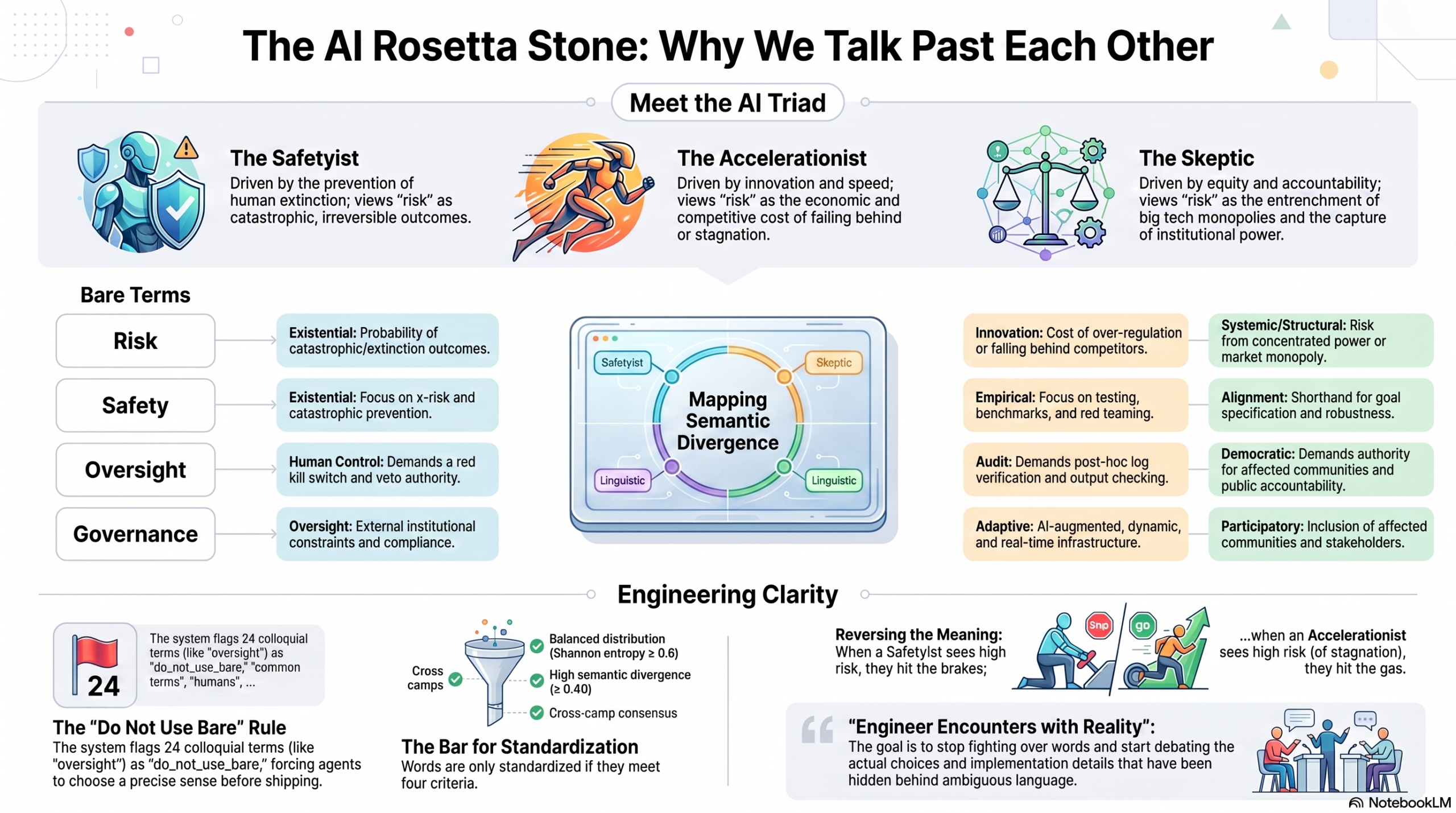
- The Safetyist thinks risk means human extinction.
- The Accelerationist thinks risk means the economic cost of falling behind because a regulator made them fill out forms.
- The Skeptic thinks risk means big tech companies quietly writing the rules to entrench their own monopolies.
Same word. Three completely different realities.
Humpty Dumpty said it best: “When I use a word, it means just what I choose it to mean – neither more nor less.”
In the civic conversation around AI policy, the bare word “risk” is ground zero for confusion – a total clarity killer. A lack of precise terminology means we don’t even know where we actually agree or disagree. These conversations matter, so we need to fix this.
A Dictionary of Words You May Not Use Bare
In my AI Rosetta Stone project, I built a system to force clarity.
I created a taxonomy of 24 colloquial terms and 45 standardized senses. In my engine, every single one of these terms is flagged DO_NOT_USE_BARE. The system literally blocks an agent from shipping words like “safety,” “risk,” or “oversight” as-is. You are forced to resolve the term to a precise, standardized sense first.
Why? Because bare words are the seeds of false harmony.
| Term | Standardized Sense | Core Definition | Cohort Co-occurrence |
| risk | existential | Probability of catastrophic / extinction outcome | x-risk, existential, irreversible (Safetyist) |
| innovation | Cost of over-regulation or economic stagnation | competitive disadvantage, falling behind (Accelerationist) | |
| systemic_structural | Harm from concentrated power or market capture | monopoly, capture, institutional failure (Skeptic) | |
| safety | existential | Focus on extinction-level mitigation | extinction, catastrophic (Safetyist) |
| empirical | Empirical verification and software robustness | testing, benchmarks, validation (Accelerationist) | |
| alignment | Mathematical/goal specification constraints | alignment, goal specification (Skeptic) | |
| oversight | human_control | Human veto power and kill switches | human-in-the-loop, kill switch (Safetyist) |
| audit | Empirical post-hoc verification and logging | audit, monitoring, evaluation (Accelerationist) | |
| democratic | Institutional and community accountability | participatory, public, standing (Skeptic) | |
| governance | oversight | External institutional constraints and regulation | compliance, monitoring (Safetyist) |
| adaptive | Dynamic, real-time, AI-augmented infrastructure | adaptive, real-time (Accelerationist) | |
| participatory | Community-led and stakeholder-inclusive frameworks | stakeholder, representation (Skeptic) |
Talking Past One Another
Take a standard sentence from a Congressional hearing: “We need stronger oversight of AI.”
Everyone in the room nods. Now resolve the bare word oversight:
- The Safetyist demands human_control – a giant red kill switch and veto power.
- The Accelerationist demands audit – post-hoc log verification after the product ships.
- The Skeptic demands democratic – handing decision authority over to affected communities.
That isn’t consensus. That is talking past one another.
You have three completely different mechanisms – a kill switch, an audit log, and a community veto – all hiding behind a single noun. Lawmakers vote “yes” on the same sentence, leave the room, and spend two years fighting like hell over implementation because nobody agreed on the physics of what they were building.
Worse, bare words don’t just split meaning – they can invert vector directions.
When a Safetyist says “risk is too high,” they hit the brakes.
When an Accelerationist says “risk is too high,” they mean the risk of stagnation, so they hit the gas.
They are using identical grammar to command opposite actions.
Engineering Encounters with Reality
As leaders, it is our job to engineer encounters with reality. No one benefits from being disconnected from reality – especially if they don’t like that reality.
The goal of the AI Rosetta Stone tool is to detect when camps use shared language to mask conflicting realities, and force precision. Grounded in computational linguistics, the framework relies on three strict principles rather than gut feelings:
- A Strict Entry Bar: A term only gets standardized if it meets four hard mathematical and analytical criteria: cross-camp usage, balanced distribution (Shannon Entropy -ge 0.60), high semantic divergence (Distance -ge 0.40), and human validation. For example, “compute” had high distribution but low semantic divergence – everyone roughly meant the same thing – so I didn’t force a split.
- Refusing Fake Certainty: If the system cannot resolve a term with threshold confidence, it explicitly flags the usage as ambiguous. Forcing a clean reading onto a muddy statement is just manufacturing fake confidence.
- The Coinage Log: Standardized senses are explicit engineering constructs, not natural discoveries. Most senses are marked coined_for_taxonomy and stored in an append-only log. I don’t pretend I found these concepts sitting under a rock in nature – I engineered them to give policy debates an auditable history.
Generating Clarity
Splitting these terms does not settle which camp has the right vision. It simply forces us to argue about the actual choices rather than the labels we slap on them. Once we strip away the semantic ambiguity, we can stop fighting over words and start debating the actual issues of AI policy.
“It’s a show about pedantry” – Frankie Boyle, Taskmaster Series 15, Episode 9