I have a lot of conversations where teams toss around the concept of Product Market Fit (PMF) like it’s a vibe. We all pretend to get the gestalt of it, but usually, we’re just guessing. Here are explanations my teams have used over the years:
Is your Hair on Fire?You have PMF when the customers are buying the product as fast as you can make it—or usage is growing as fast as you can add more servers.
How would you feel if you could no longer use this product?If at least 40% of them answer “very disappointed,” you have reached the threshold. Anything less means you are building a toy, not a necessity.
Since I got involved in angel investing, I learned the cold truth from my fellow investors: PMF is MATH!
Here are a couple of calculations that tell you whether you have found PMF.
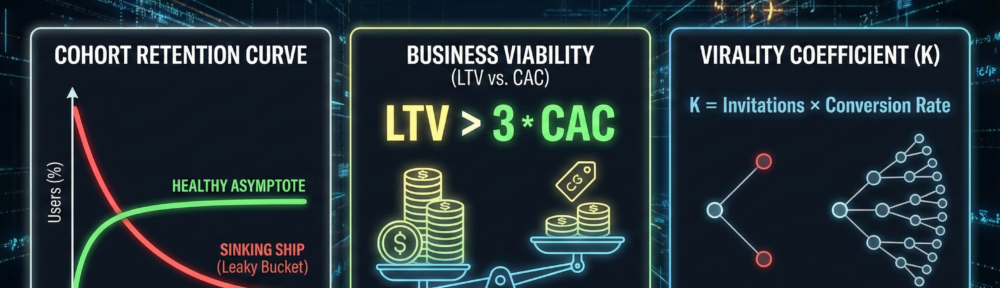
Cohort Retention Curve
A critical metric is Cohort Retention Curve. Some argued that everything else is friction. When you look at your telemetry, look for a specific mathematical shape. If you plot your users over time and that line keeps sinking toward the X-axis, your ship is sinking.
A healthy product is defined by an asymptote. You need a percentage of users who never leave—the line must flatten out. If that line hits zero, your product is a hallucination. It doesn’t matter if you have a million sign-ups today if your churn rate burns through your user base by next month. I see teams obsessing over top-of-funnel growth while their retention curve is a vertical drop. That is a leaky bucket. You are burning capital to acquire people who hate your implementation enough to leave forever. If that curve doesn’t stabilize, stop coding. Your current solution is a delusion.
NOTE – you only have one chance to make a first impression. A decade ago I used Siri and decided it sucked. I haven’t tried it again but will still tell everyone that it sucks.
Business vs Charity
If your unit economics requires a miracle to break even, you better start praying. The math of a viable business is a law of physics. A good rule of thumb is that customer LifeTimeValue (LTV) should be greater than 3 times the Customer Acquisition Cost (CAC).
LTV > 3 * CAC
Why?
LTV < CAC ; you’re losing money
LTV ~ 2 * CAC ; you’ve on thin ice. Low margins means few funds to drive change and growth
If you are paying more to get a customer than you will ever earn from them, you are running a charity subsidized by investors. Scale only magnifies a broken model. If you can’t earn back the cost of acquisition in under a year, you don’t have a Plausible Theory of Success.
Virality Coefficient
Some founders are just paying for attention. If your Virality Coefficient is less than one, you are pushing a boulder up a hill. You spend a dollar to get a user, and that user dies alone in your database.
K = number of invitations sent * conversion rate
When K > 1, the market is pulling the product out of your hands. It is the mathematical difference between a linear slog and a pandemic. If your product doesn’t naturally compel a user to bring in more than one other person, your value proposition is missing a fundamental hook. You are trying to manufacture growth because you failed to ship a necessity.
This is where you have to be honest about your Welcome To The Room moment. In that blog, I point out that you must always monitor your Plausible Theory of Success. Tracking these PMF metrics isn’t a “nice to have” activity; it is the primary way you determine whether your theory is actually plausible or just a fairy tale you’re telling yourself. Scale only magnifies a broken model. If you can’t earn back the cost of acquisition in under a year, you don’t have a Plausible Theory of Success.
So do the math.
Respect reality.
If the math doesn’t pencil out, you are failing.
You no longer have a plausible theory of success.
Stop.
Focus on getting a new plausible theory of success.
You mentioned that if your cohort curve is dropping, the product might be a ‘hallucination.’ This hit home for me—sometimes we focus so much on acquiring new users that we forget about those who are already using the product. What’s your advice for balancing both aspects effectively?
I like the way you presented it. Sending a link to my students 🙂